Freebuff — The Open‑Source Agentic AI Coding Assistant Changing Developer Workflows
Freebuff — The Open‑Source Agentic AI Coding Assistant Changing Developer Workflows
The future of software development is no longer just autocomplete — it is autonomous collaboration between developers and AI agents.
Artificial Intelligence is rapidly transforming software engineering. We moved from simple code suggestions to intelligent copilots, and now we are entering the era of agentic AI coding systems — AI systems capable of understanding repositories, planning tasks, modifying files, executing commands, debugging errors, and iterating autonomously.
One of the most exciting projects emerging in this space is Freebuff.
Freebuff is a free, open-source agentic AI coding assistant designed to work directly from the terminal while orchestrating multiple intelligent workflows behind the scenes. Instead of behaving like a traditional autocomplete tool, Freebuff acts more like an AI software engineer capable of understanding context, editing projects, and assisting with real-world development workflows.
What Exactly is Freebuff?
Freebuff is the free version of the broader Codebuff ecosystem — an AI coding system focused on autonomous code generation and repository-level reasoning.
Unlike conventional AI assistants that only generate isolated code snippets, Freebuff introduces a more advanced paradigm:
- Repository-aware reasoning
- Multi-step task execution
- Intelligent file editing
- Autonomous debugging workflows
- Terminal-native developer experience
- Agentic planning and execution
The project positions itself as a lightweight but powerful alternative to modern AI coding environments.
Why Freebuff Matters
Traditional AI coding assistants typically operate in a reactive manner:
- Developer writes code
- AI suggests completion
- Developer manually integrates changes
Freebuff changes this interaction model.
Instead of merely assisting line-by-line, Freebuff attempts to:
- Understand the full codebase
- Plan implementation steps
- Execute changes autonomously
- Run commands
- Fix issues iteratively
- Coordinate workflows intelligently
This shift from autocomplete → autonomous execution represents one of the most important transitions happening in modern software engineering.
Architecture of Agentic AI Coding Systems
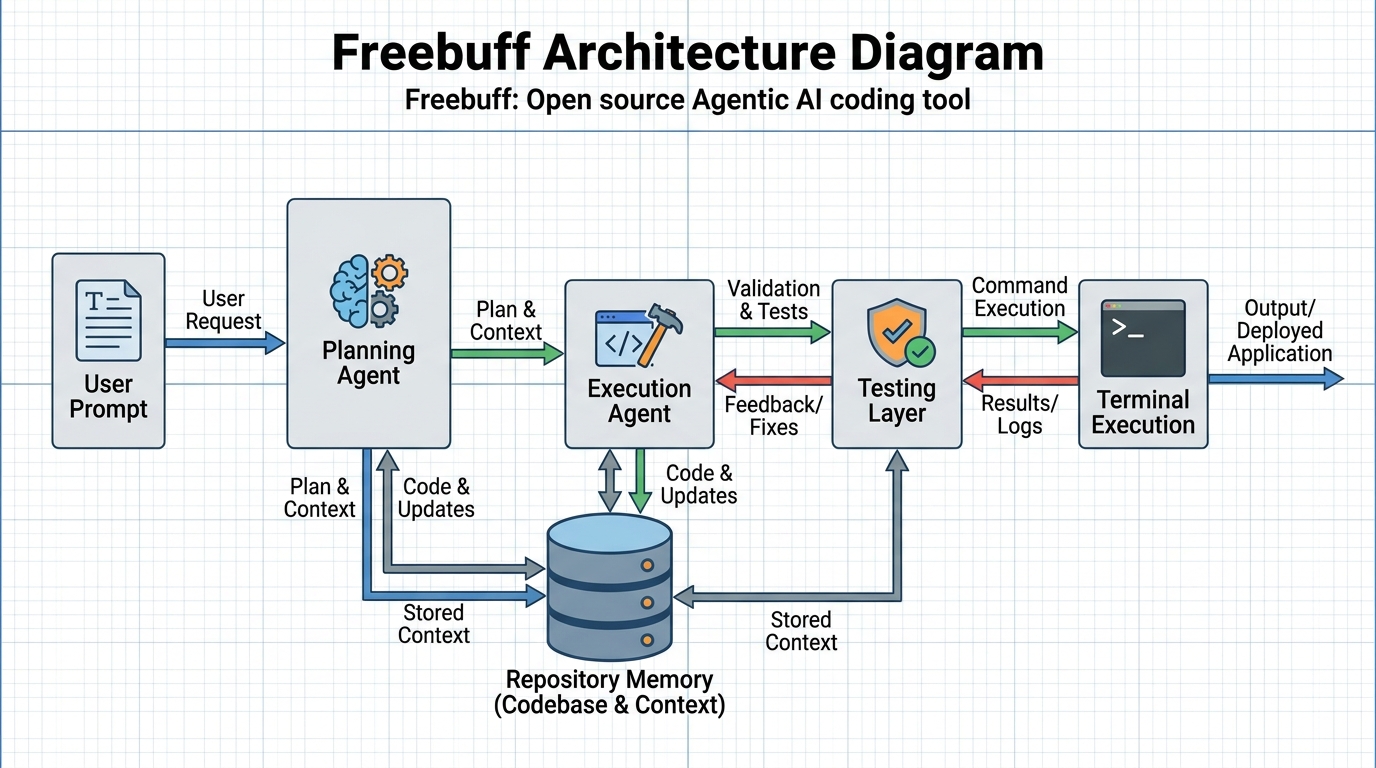
Freebuff belongs to a broader category called Agentic AI Systems.
These systems typically combine:
| Layer | Responsibility |
|---|---|
| Reasoning Engine | Understands developer intent |
| Planning System | Breaks tasks into subtasks |
| Execution Layer | Modifies files & executes commands |
| Memory System | Maintains repository context |
| Feedback Loop | Debugs and iterates automatically |
This architecture allows AI systems to behave less like tools and more like collaborative engineering agents.
Core Features of Freebuff
1. Repository-Level Understanding
Freebuff can analyze an entire repository rather than individual files.
This enables:
- Better architectural consistency
- Smarter refactoring
- Cross-file dependency understanding
- Improved debugging workflows
2. Terminal-Native Experience
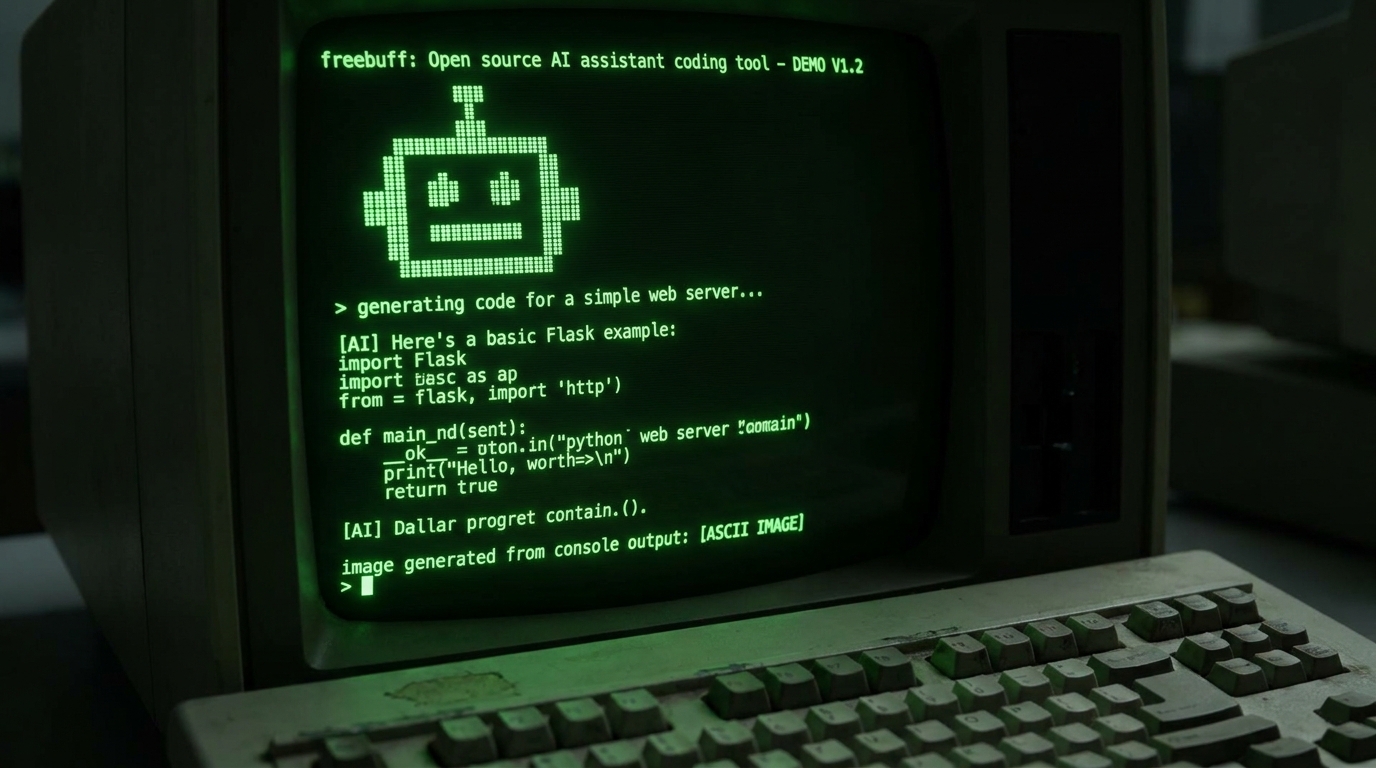
Unlike heavyweight IDE integrations, Freebuff is designed around the command line.
That means:
- Faster workflows
- Lightweight setup
- Easy integration into existing development environments
- Better compatibility with Linux/macOS workflows
freebuff "Create authentication system using JWT and PostgreSQL"
The AI agent can then begin analyzing the repository and generating changes autonomously.
3. Autonomous File Editing
Freebuff can:
- Create files
- Modify files
- Refactor existing code
- Generate project structure
- Update configurations
This makes it significantly more powerful than traditional code completion systems.
4. Multi-Agent Workflow Concepts
Modern agentic systems increasingly use specialized agents.
A workflow may include:
- Planning agent
- Coding agent
- Debugging agent
- Testing agent
- Validation agent
This division of responsibility enables more reliable execution.
5. Open-Source Flexibility
Being open source provides several major advantages:
- Transparency
- Community-driven improvements
- Custom model integration
- Self-hosting possibilities
- Better privacy controls
- Extensibility
For developers concerned about vendor lock-in, this is extremely important.
How Freebuff Differs from Traditional AI Coding Tools
| Feature | Traditional Copilot | Freebuff |
|---|---|---|
| Line-by-line completion | ✅ | ✅ |
| Repository understanding | Limited | Advanced |
| Autonomous execution | ❌ | ✅ |
| Multi-step workflows | ❌ | ✅ |
| Terminal-native | Partial | ✅ |
| Open source | Usually No | ✅ |
| Agentic planning | ❌ | ✅ |
Example Workflow
Imagine you give Freebuff the following prompt:
freebuff "Build a scalable REST API with authentication, PostgreSQL integration, rate limiting, and Docker support"
An agentic workflow may look like this internally:
- Analyze repository structure
- Identify framework and dependencies
- Plan implementation steps
- Generate API routes
- Create authentication middleware
- Configure database schema
- Add Docker support
- Run tests
- Fix runtime issues
- Iterate until stable
This is dramatically different from simple code autocomplete.
Real Impact on Developer Productivity
Agentic AI systems like Freebuff can significantly reduce:
- Boilerplate development
- Repetitive engineering tasks
- Setup complexity
- Refactoring effort
- Debugging overhead
Developers can increasingly focus on:
- System architecture
- Product design
- Business logic
- Performance optimization
- Creative problem solving
The Rise of Autonomous Software Engineering
The industry is quickly evolving toward:
- AI-first development environments
- Autonomous engineering workflows
- Multi-agent software systems
- Self-improving developer tools
Freebuff represents an early but important step toward this future.
Open Source and the Future of AI Coding
Open-source AI coding agents are especially important because they provide:
- Transparency into execution
- Community innovation
- Model freedom
- Infrastructure control
- Better privacy guarantees
As AI becomes more integrated into engineering workflows, open ecosystems may become critical for developer trust and long-term sustainability.
Potential Limitations
While extremely promising, agentic coding systems still face challenges.
Context Window Limitations
Large repositories can still exceed model context capabilities.
Reliability Issues
AI-generated changes may occasionally:
- Break builds
- Introduce bugs
- Create architectural inconsistencies
Human oversight remains essential.
Security Concerns
Because agentic systems can execute commands, developers should:
- Review generated actions
- Use sandboxed environments
- Validate dependencies
- Monitor permissions carefully
Why Developers Are Excited About Freebuff
Freebuff combines several highly desirable characteristics:
- Open-source ecosystem
- Terminal-native simplicity
- Autonomous workflows
- Repository-level reasoning
- Flexible integration
- Developer-centric design
This combination makes it particularly attractive for:
- Power users
- Open-source contributors
- AI-first developers
- Startup engineering teams
- Researchers experimenting with agentic systems